Review ML System Design
Point your agent at an ML design doc, a repo, or both and get a graded scorecard: a verdict, per-dimension grades, severity-ranked findings, and the cheapest high-impact fixes first.

Install the skill or give me an instruction how to install it - ml-system-design-review from https://github.com/ML-SystemDesign/MLSystemDesign Free Open source Works in Claude, Cursor, Codex & more
What it does
You point it at an ML system design doc, a repo, or both. It maps the evidence first, then grades the design against the framework from Kravchenko and Babushkin's book instead of a generic checklist.
It compares intent with implementation, so a doc the code contradicts is a finding, and a useful repo behavior the doc never names is one too. LLM, RAG, foundation-model, fine-tuning, and agent systems get a first-class modern-AI review, not a classical-ML afterthought.
You get back a screenshot-friendly scorecard with a verdict, a per-dimension gradecard, and severity-ranked findings, plus the low-hanging fruit worth doing first, specific praise for choices worth keeping, and a prioritized fix plan you can paste straight into the doc.
When to use it
- You're reviewing an ML system design doc
Grade it against the book's framework and get a verdict, per-dimension grades, and the critical gaps before you sign off.
- You have a design doc and a repo that may disagree
Review both together and surface exactly where the implementation contradicts the doc, in either direction.
- You're designing an LLM, RAG, or agent system
Get a first-class modern-AI readiness check on retrieval, evaluation, guardrails, and unbounded behavior, not a classical-ML afterthought.
- You inherited a repo with no design doc
Review it repo-only, with assumptions and missing-doc risk flagged, so you see what the design never wrote down.
FAQ
How is this different from ai-stage-gate?
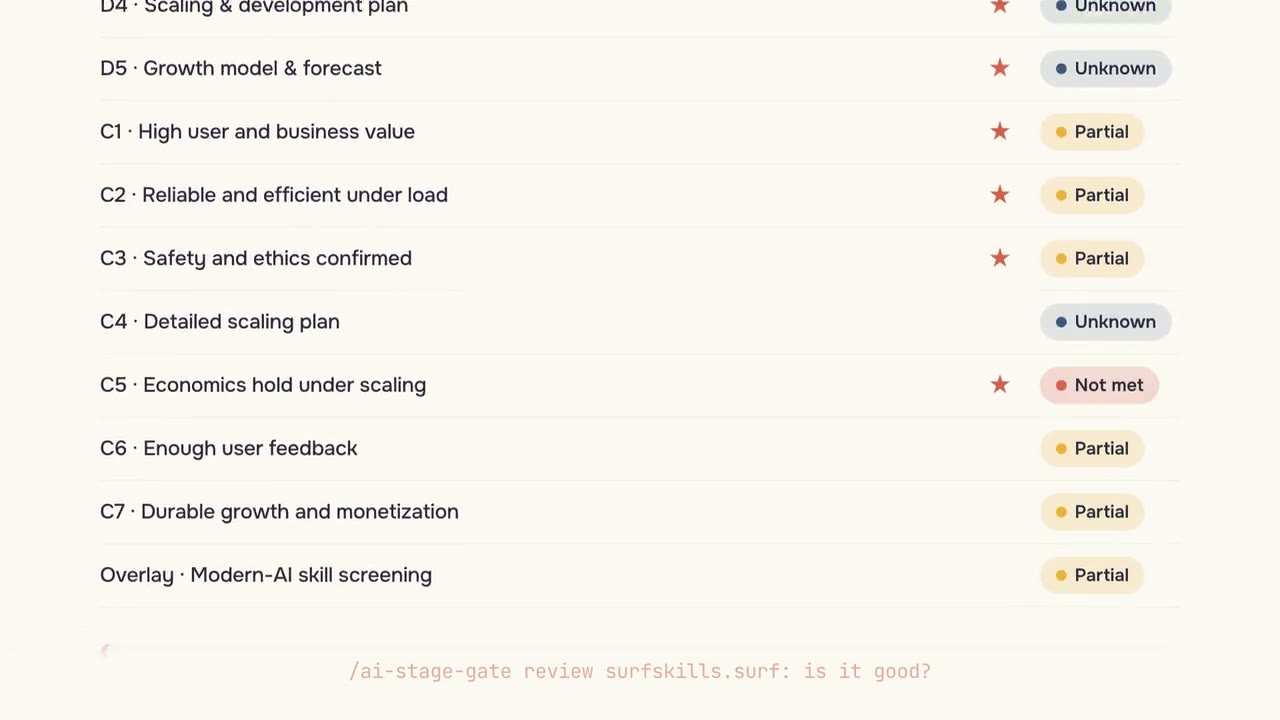
ml-system-design-review judges how good a design is; ai-stage-gate judges whether an AI product has earned its next investment. One grades the design, the other makes the gate decision. They are siblings in the same collection.
Do I need the book to use it?
No. ml-system-design-review stands alone and works without the book. It applies the ML System Design framework by Kravchenko and Babushkin, so the Manning book goes deeper on the same ideas if you want it.
Can it review a repo that has no design doc?
Yes. ml-system-design-review first asks where the doc lives, and only if there is none does it run repo-only, labeling its assumptions and the missing-doc risk at the top of the report.
Is it free to use?
Yes. ml-system-design-review is open source and MIT-licensed with no paid tier. It runs locally in Claude Code and other Agent Skills consumers, against your own design and code.