 Conor Bronsdon · @conorbronsdon ↗
 Avoid AI Writing
A portable writing skill that audits and rewrites text to strip AI tells ('delve', em dashes, inflated significance, and dozens more), then scores how clean it reads with a runnable 0-100 detector.
The roster
What it does
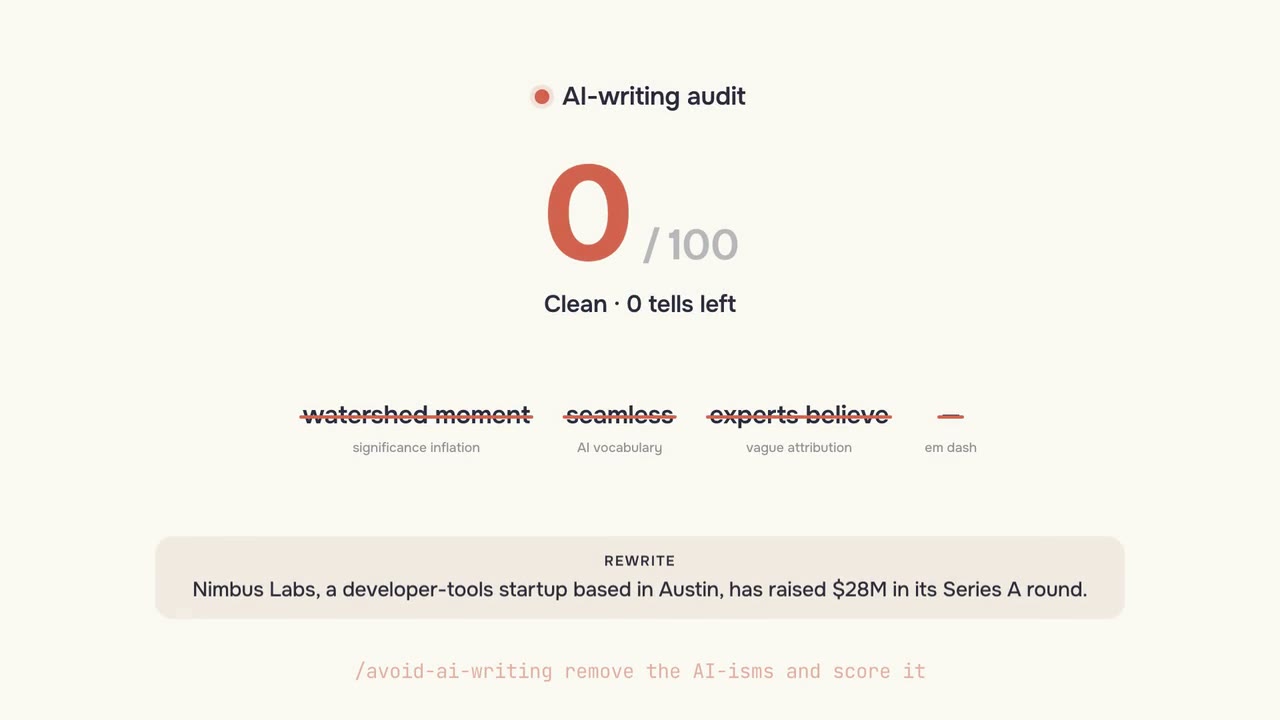
Avoid AI Writing is a skill for making machine-written text read like a person wrote it. You hand it a draft and it flags the AI tells, rewrites them, and can score the result, so 'delve', 'seamless', em dashes, and inflated significance stop giving your work away.
It runs anywhere your agent does, from Claude Code and Cursor to OpenClaw. Under the hood it carries a 109-word replacement table across three tiers, 51 documented pattern categories, voice and context profiles (blunt for a memo, casual for a post), and a deterministic detector that turns the flags into a single 0-100 score you can check in code.
When to use it
- Your draft reads like AI wrote it
Flag the AI tells and rewrite them so the text sounds like a person, not a model.
- You want to audit without changing the text
Detect mode quotes every AI-ism and rates its severity, leaving published or someone else's writing untouched.
- You want a number, not a vibe
Score any draft 0-100 with the bundled detector, so 'is this too AI?' has an answer you can check.
Common questions
Is Avoid AI Writing free?
Yes. Avoid AI Writing is open-source (MIT) with no paid tier. It runs locally through your agent with no API keys, and the detector is zero-dependency.
How is it different from a 'make this sound human' prompt?
It runs a structured audit that quotes each issue, rewrites, then does a second corrective pass. It carries 51 documented patterns, a tiered word table, and voice and context profiles, instead of a one-shot guess.
Which agents does it work with?
Any agent that reads the agentskills.io SKILL.md format, including Claude Code, Cursor, OpenClaw, Hermes, and Codex. A ported Cursor rule ships in the repo.
Does it change my text or just flag it?
Your choice of mode. Rewrite returns a clean copy, detect only flags issues by severity, and edit makes minimal in-place edits to a file you name, leaving already-human passages alone.